40 years since the first microprocessor: the Intel 4004
11/10/2011
Post by
Epifanio Blanco
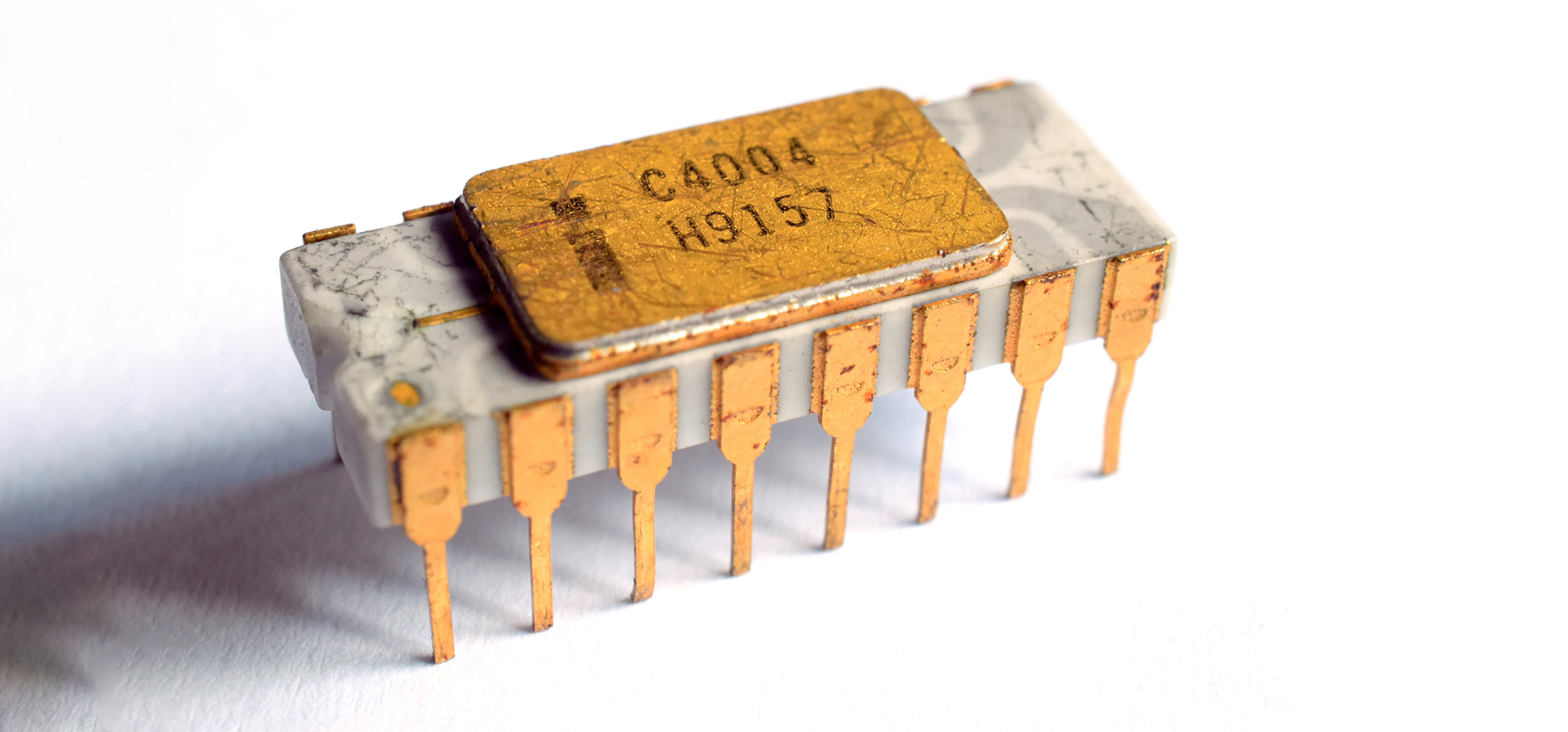
On November 15, 1971, Intel launched its first microprocessor: the Intel 4004. The Intel 4004 (i4004), a 4-bit CPU, was the first microprocessor built on a single chip, as well as the first one available commercially. The Intel 4004 made it possible to fit, on a 0.25-square-centimeter board, an integrated circuit containing 2,300 transistors.
The goal was to bring together, in a single microprocessor, all the elements needed to build a computer, with the exception of input and output devices (keyboard, screen, printer, etc.), which were impossible to miniaturize. The 4004 was designed and implemented by Federico Faggin between 1970 and 1971. As soon as he joined Intel, Faggin created a new "random logic design" methodology using Silicon Gate technology, which had not existed before, and which was used to fit the microprocessor onto a single chip. This methodology was used in all of Intel's earliest microprocessor designs. The 4004 was highly effective for use in calculators and control devices. This first processor had features that were unique for its time, such as a clock speed that exceeded 100 KHz (kilohertz).
On April 1, 1972, Intel announced an improved version of its processor. This was the 8008, and its main advantage over other models was the ability to access more memory and process 8 bits. Its clock speed reached 740 KHz.It was the first 8-bit microprocessor, built using PMOS technology, featured 48 instructions, could execute 300,000 operations per second, and could address 16 Kbytes of memory.
In April 1974, Intel launched the Intel 8080, with a clock speed reaching 2 MHz.
The following year, the first personal computer, named the Altair, hit the market, based on the Intel 8080 microarchitecture. This computer's processor delivered 10 times the performance of its predecessor thanks to its 2 MHz speed.This microprocessor also addressed 8 bits, had 78 instructions, had an operating speed 10 times higher than the 8008, and could address up to 64 Kbytes of memory.
In 1977, the Intel 8085 hit the market, an 8-bit processor that was binary-compatible with the earlier i8080, but required less hardware support, allowing for simpler microcomputer systems.
In June 1978 and 1979, the 8086 and 8088 microprocessors made their appearance, going on to power the IBM PC, which launched in 1981.The i8086 and i8088 were based on the design of the Intel 8080 and Intel 8085, and are in fact assembly-language compatible with the i8080.Both have four general-purpose 16-bit registers, which can also be accessed as eight 8-bit registers, and have four registers.
On February 1, 1982, Intel gave the industry another shake-up with the arrival of the first 80286 (the famous "286" computer), with a speed between 6 and 25 MHz and a design much closer to today's microprocessors.
The 286 has the honor of being the first microprocessor used to mass-produce clone computers, and thanks to the "cross-licensing" system, the first "IBM compatible" clone manufacturer emerged: Compaq, which, using this microprocessor, began manufacturing desktop computers in 1985 and using the microprocessors that Intel/IBM released to the market.
On October 16, 1985, Intel launched the i80386, with x86 architecture. It was used as the central processing unit of many personal computers from the mid-1980s through the early 1990s.It is also known as the 386, with a clock speed between 16 and 40 MHz, and stood out mainly for being a microprocessor with 32-bit architecture.
In 1988, Intel developed, somewhat late, a simple system for upgrading the old 286 with the arrival of the 80386SX, which sacrificed the data bus, reducing it to 16 bits, but at a lower cost.
These processors emerged alongside the explosion of the Windows graphical environment, developed by Microsoft a few years earlier but which had not yet gained enough acceptance among users.
On April 10, 1989, the Intel 80486DX appeared, again with 32-bit technology, and its main new feature was the addition of Level 1 (L1) cache on the chip itself, which greatly sped up data transfer from this cache to the processor, along with the appearance of the math co-processor.
In 1989, they launched the i486, which reached speeds between 16 and 100 MHz. These microprocessors were very similar to the Intel 80386, with the main difference being that the i486 had an optimized instruction set, a floating-point unit, and a unified cache built into the microprocessor's own integrated circuit, along with an improved bus interface unit.These improvements made the i486 twice as fast as an i386 and i387 at the same clock frequency.
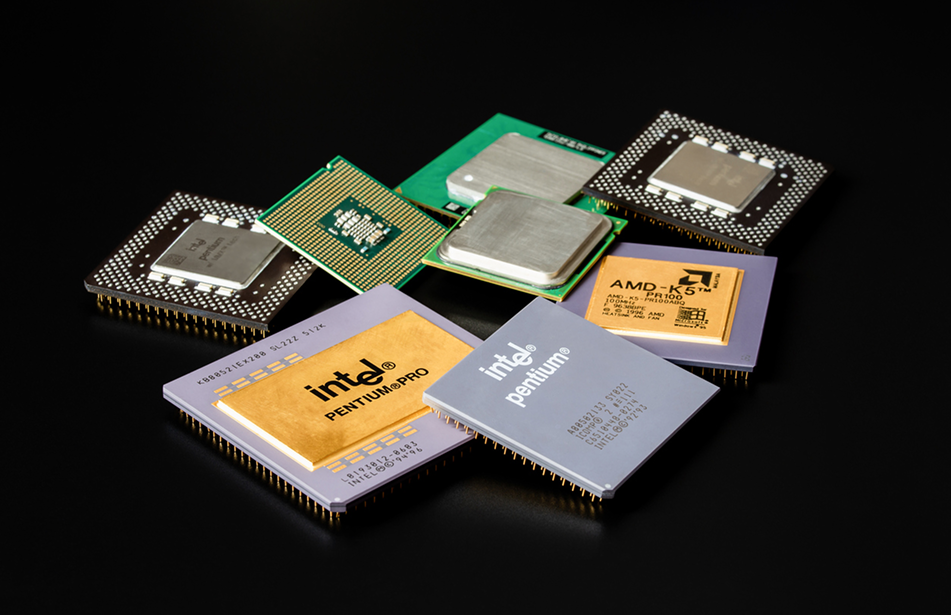
On March 22, 1993, the "Pentium" saw the light of day for the first time, also known by the code name P54C. These processors started at an initial speed of 60 MHz, reaching up to 200 MHz — something no one had been able to predict a few years earlier. With a true 32-bit architecture, it once again used .8-micron technology, which made it possible to fit more units into less space.The Pentium featured an architecture capable of executing two operations at once, thanks to its two 32-bit data pipelines, one equivalent to the i486DX(u) and the other equivalent to the 486SX(u).It had a 64-bit data bus, allowing 64-bit memory access.
On March 27, 1995, the Pentium Pro processor brought a breath of fresh air to network servers and workstations, much as the Pentium had done in the home computing space. The Pentium Pro is the sixth generation of x86 architecture, which aimed to replace the Intel Pentium across the full range of applications, but later became focused as a chip for the server world and high-end desktop equipment, being the first one aimed at business.
On March 7, 1997, Intel released the Intel Pentium 2 to the market, with x86 architecture, based on a modified version of the P6 core, first used in the Intel Pentium Pro. Compared to its predecessor, this one improves performance when running 16-bit code, adds the MMX instruction set, and removes the second-level cache from the processor core itself, placing it instead on a printed circuit board alongside it. It had 32 KB of first-level cache, split into 16 KB for data and another 16 KB for instructions.
In 1998, the first Xeon processor appeared, named the Pentium II Xeon, which used both the 440GX and 450NX chipsets. In 2001, the Pentium III Xeon was replaced by the Intel Xeon processor.
On February 26, 1999, the Pentium III arrived, a microprocessor with i686 architecture, built as a modification of the Pentium Pro. The first versions were very similar to the Pentium II, with the most important difference being the introduction of SSE instructions; as with the Pentium II, there was a budget Celeron version and a XEON version for those who needed greater computing power.
On November 20, 2000, the Pentium 4 hit the market, a seventh-generation microprocessor based on the X86 architecture, with a design that was completely new since the 1995 Pentium Pro. The last Pentium 4 was made on August 8, 2008, after which it was replaced by the Intel Core Duo.
In March 2003, the Intel Pentium M arrived, a microprocessor with x86 (i686) architecture, representing a radical shift for Intel, since it was not a low-power version of the Pentium 4, but rather a heavily modified version of the Pentium III design (which was itself a modification of the Pentium Pro). It is optimized for efficient power consumption, a vital feature for extending laptop battery life. It runs with very low average power consumption and gives off much less heat than desktop computer processors. Intel Pentium M processors are an integral part of the Intel Centrino platform.
At the Spring 2005 Intel Developer Forum, the Pentium D processors were introduced, essentially consisting of 2 Pentium 4 processors packed into a single package (2 Prescott cores for the Smithfield core, and 2 Cedar Mill cores for the Presler core). Its manufacturing process was initially 90 nm, moving to 65 nm in its second generation. Its code name before launch was "Smithfield."
On June 26, 2006, Intel announced the new generation: Xeon Dual Core, with dual-core technology.
This new processor delivers 80% more performance per watt and is 60% faster than the competition. In addition, the new generation offers more than double the performance of the previous generation of servers based on the Intel Xeon processor, capable of running both 32-bit and 64-bit applications. The Core 3 brand was introduced on July 27, 2006, covering the SOLO (single-core), DUO (dual-core), QUAD (quad-core), and EXTREME (dual- or quad-core CPUs) lines. Intel Core 2 processors with vPro technology (designed for business) include both the dual-core and quad-core branches.
The Core 2 brand refers to a range of Intel's commercial 64-bit dual-core CPUs and quad-core 2×2 MCM (multi-chip module) CPUs with the x86-64 instruction set, based on Intel's Core Microarchitecture, derived from the 32-bit dual-core mobile processor. On November 2, 2006, the Intel Core 2 Quad appeared, a series of processors with 4 cores, claimed to be 65% faster than the previously available Core 2 Duo.
To create this processor, 2 Core cores had to be packaged together and connected via the System Bus, for a total of 4 real cores.
On March 2, 2008, Intel announced the arrival of Intel Atom, the name of a line previously called Silverthorne / Diamondville. Designed for a 45 nm CMOS manufacturing process, they were intended for use in mobile internet devices, ultraportables, smartphones, and other low-power devices and applications.
In 2010, Intel announced the quad-core Core i3, i5, and i7 models, a family of processors that cover the processing needs of every user level, depending on their profile and lifestyle. Core i3 delivers a fast, flexible computing experience.
Equipped with Intel's accelerator for high-definition graphics media, an advanced video engine that offers smooth video playback, as well as advanced 3D capabilities, making it an ideal graphics solution for everyday use. Core i5 automatically allocates processing power where it's needed most, letting users create HD videos, compose digital music, edit photos, or play video games. And for more experienced users, the Core i7 stands out as the best option, offering major advantages when running applications that demand higher performance.
Intel's 2010 Core family features Hyper-Threading technology, which allows each processor core to work on two tasks at the same time, delivering the performance users need to run multiple tasks at once. Meanwhile, Intel Core i5 and Intel Core i7 include Turbo Boost, which automatically increases core processing speed above the base operating frequency, as long as the specified power, current, and temperature limits have not been reached.
In January 2011, Intel launched the second generation of the Core family, technology that includes changes to the cache memory, improvements to Turbo Boost mode, and refinements to the architecture itself.
This new family has an integrated graphics engine to boost a device's processing and graphics performance while maintaining energy efficiency, providing the perfect balance between design, performance, and durability. They feature enhanced visual capabilities, focused on the areas most users rely on their computers for today: high-definition video, 3D, gaming, multitasking, and social networking or online multimedia use.
Built on Intel's 32-nanometer (nm) process technology, the new chips are the first "visibly smart" microarchitecture that combines visual and 3D graphics technology with top-performing microprocessors on a single chip, without the need for additional hardware to boost gaming performance or other demanding tasks.